Campus Couture: The Runway Returns at Imperial College London
On February 28, 2026, something long-awaited finally returned to the stage at Imperial College London. After nearly two years without a show, Imperial’s student fashion runway made its comeback, bringing together designers, models, and creatives from across the university for a night that blended science, storytelling, and style.
We at The Edge were there to see it firsthand, watching the long-awaited revival unfold both on the runway and behind the scenes.
For many students, the return meant more than just another campus event. It marked the revival of a creative tradition that had existed at Imperial for decades.
Student organizer and model Alex Chaduteau (@alex.chdt) explains that the show had been missing for longer than many students expected. “Imperial fashion shows existed for decades,” he says. “It hasn’t happened for a year or two, and that was a shame because a lot of science students are interested in fashion. We’re trying to revive it and make it become a brand again.”

Graphic created by Elise Whitaker, Photo courtesy of @sks.photo.graphy
Judging by the energy and commentary from participating models and designers alike in the room, the revival was well underway.
Fashion With a Message
One of the most striking elements of the show that we noticed was how deeply personal many of the collections felt. Several designers used their pieces to explore identity, heritage, and sustainability.
Designer Madeleine Lee (@_madeleine.__13) drew inspiration from questions of cultural identity and assimilation. Her work explored the tension between Western fashion structures and traditional Asian fabrics, reflecting the experience of balancing cultural heritage with modern influences. Sustainability also played a huge role in her designs, with garments incorporating repurposed materials and secondhand clothing. For Madeleine, fashion became a way to tell a cultural story. By layering fabrics and influences, her collection highlighted both acceptance of cultural background and the complexities of navigating different cultural spaces.
Similarly, another designer approached sustainability through the lens of nature and transformation. Biology major Charlotte Ams (@cha_ams11) built her collection using recycled materials such as old curtains and pillows from her grandmother’s house. The concept centered around the butterfly as a symbol of metamorphosis.
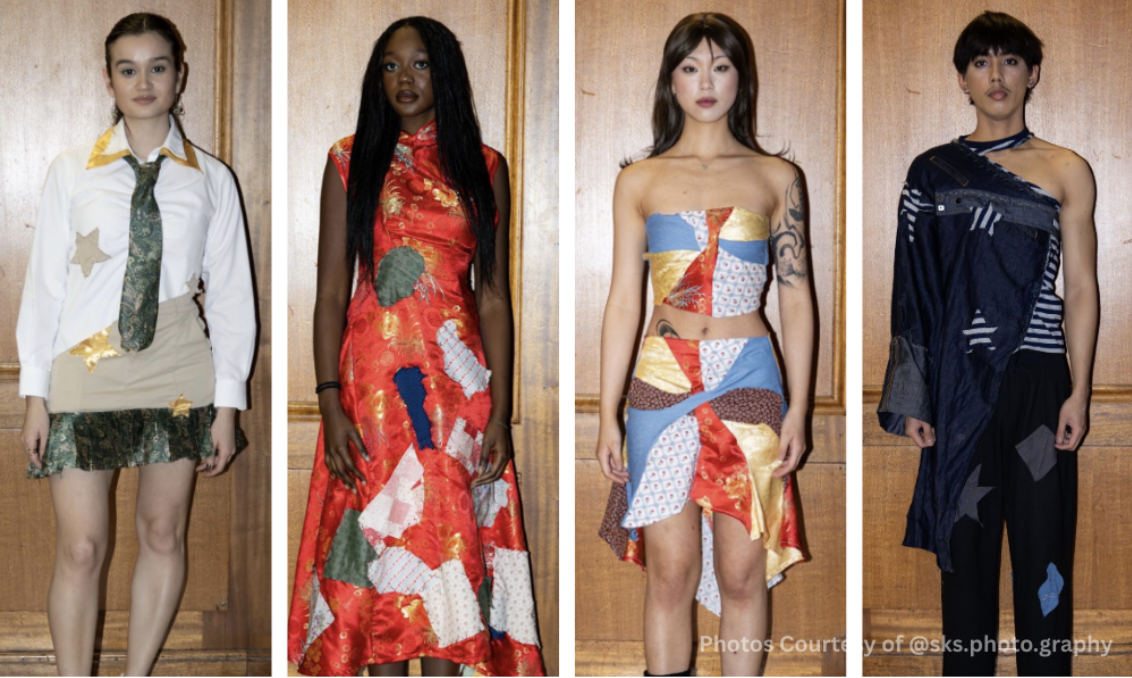
Graphic created by Elise Whitaker, Photos courtesy of @sks.photo.graphy
“The butterfly is a metaphor for reusing old things and turning them into something new,” she said.
Charlotte also noted how her academic studies influence her creative process. Many students participating in the fashion show weren’t fashion majors at all, having an interest in design as a hobby but studying medicine, biology, or mathematics. “Being a biology major reinforces the creative process because you get to see other parts of nature and how perfect and geometrical it is,” she says. Looking at her designs, we can agree that the connection between science and design became visible through the careful structure of her garments and the organic inspiration behind them.
Mathematics also found its place on the runway. Designer Gareth Volka (@garethvolka) incorporated mathematical concepts into his collection, drawing inspiration from signs, computer algorithms, and material symbolism. His work explored the patterns and logic that often sit quietly behind creative expression.
Fashion, in this sense, became another form of problem-solving.
Cultural storytelling continued with designer Elden Ang (@_elden_ang & @ganbarugarms), who brought a vibrant mix of influences to the runway. His collection incorporated elements inspired by Lunar New Year traditions, including references to zodiac animals such as the snake, tiger, and horse. He also blended Asian influences with Angolan mythology, particularly the Kongo Cosmogram, a spiritual symbol representing the cycle of life.
The result was a visual celebration of heritage, history, and symbolism stitched directly into fabric.
Environmental awareness was another theme that appeared throughout the show. Designer Anthony Nwoke (@__Ndoki) created pieces inspired by the idea of returning to the purity of the world’s beginnings. Drawing from imagery connected to the Biblical Garden of Eden, his work reflected on the state of the modern world and humanity’s responsibility toward the environment.
Handwoven elements referencing the Ndoki land in Nigeria added another cultural dimension to the collection. For Anthony, the designs served as a reminder that as humans, we must become more aware of our actions and work together to protect the planet.
The Models Bring the Energy
Of course, a runway show is never just about the clothes. The models themselves played a huge role in bringing each look to life.
When asked to describe the vibe of his outfit, model Jhonn Cannon (@dosenesx) summed it up in three words: “Flamboyant, queer, Latin.” His look also incorporated geometric elements and even 3D printed details inspired by mathematics.
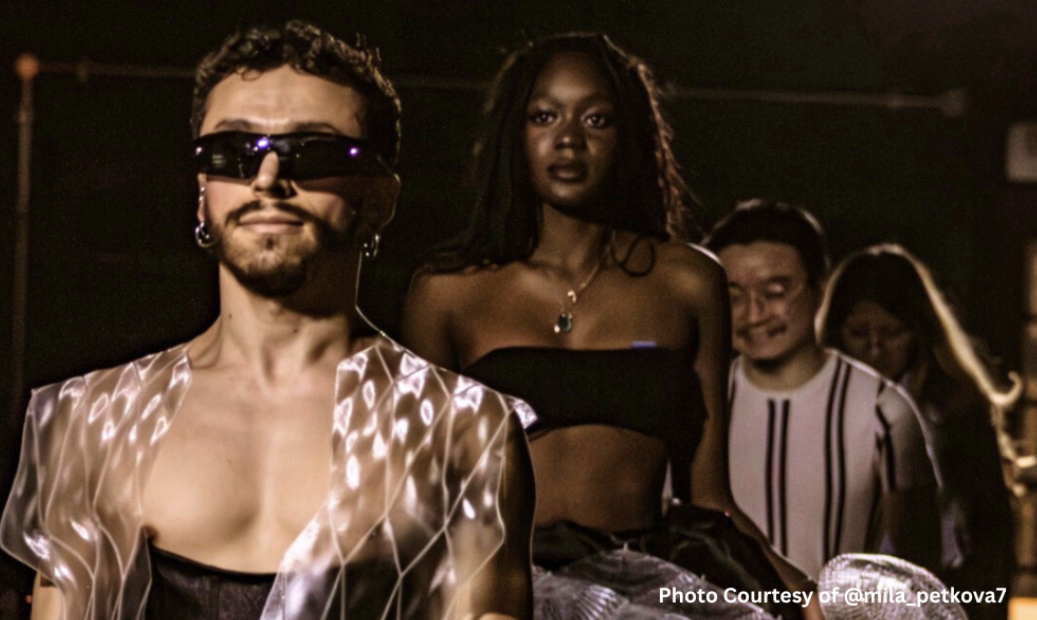
Graphic created by Elise Whitaker, Photo courtesy of @mila.petkova7
Other models described their outfits with equally vivid language. Some looks were “upcycled, funky and structured,” while others leaned into “cool, vibrant and nonchalant” aesthetics.
Model Penelope Guillard (@pene_glrd) offered perhaps the most imaginative description of all, calling her outfit an “underwater mermaid trap” with fishnets, a sultry suit, and a whimsical crocheted floral aesthetic.
Despite the creativity on stage, backstage energy remained relaxed and collaborative. Model Sara Khong (@sasicle) says the key to maintaining energy during rehearsals was simple. “Chatting to everyone,” she explains. “Everyone had good energy, and we were all excited and encouraging each other.”
Even the occasional mishap became part of the fun. When asked about the funniest moment during rehearsals, several participants laughed while recalling one unexpected challenge: the wooden shoes designed by Anthony Nwoke.
Behind the Scenes
The creative work extended well beyond the runway itself. Fellow Edge Magazine writer Elise Whitaker spent the evening with me, capturing behind-the-scenes moments throughout the practices. From outfit adjustments to the excitement, Whitaker documented the creative process as it unfolded.
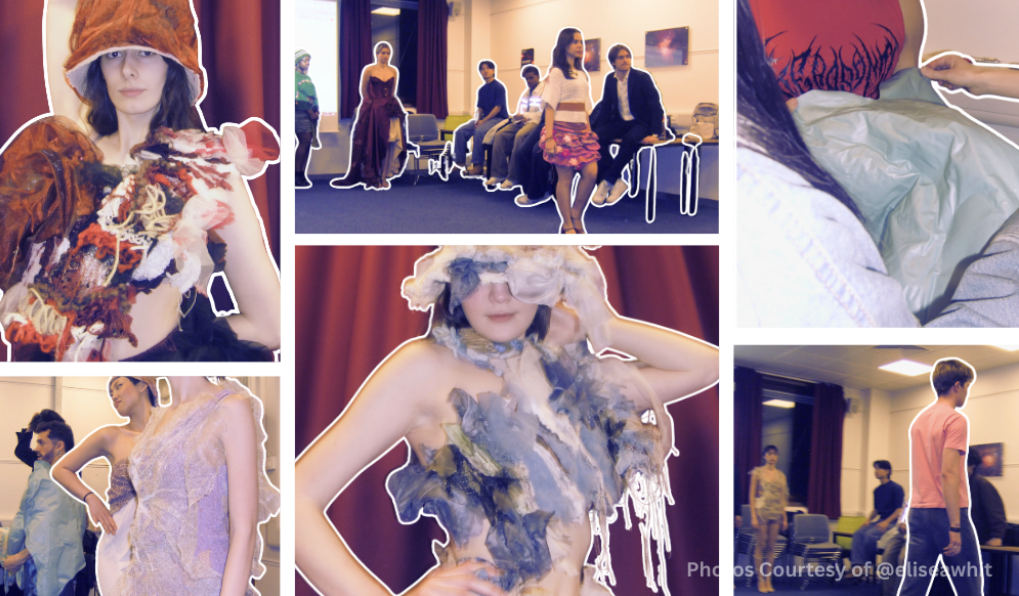
Graphic created by Elise Whitaker, Photos courtesy of Elise Whitaker
She also assisted designers by helping photograph their models after the show, ensuring they had professional images for their portfolios. The result was a collaborative atmosphere where photographers, designers, and models supported one another’s creative work.
Science Meets Style
One of the most unique aspects of the Imperial fashion show is how strongly it reflects the university’s academic identity.
Many participants study fields far removed from traditional fashion programs, including biology, medicine, and mathematics. Yet rather than limiting creativity, these disciplines often enhanced it.
For one medical student involved in the show, studying anatomy actually deepened their artistic perspective. The human body itself became a source of inspiration. “There’s a lot of beauty in the human body and the way everything works together,” designer Elden Ang explained, noting how studying the skeletal system can influence the structure of garments.
Mathematician Alex Chaduteau echoed a similar idea. “Both require creativity,” he says. “Trying to come up with new ideas.”
A New Chapter for Imperial Fashion
As the final models took their last walk across the stage and the designers took their bows, followed by rounds of applause, it became clear that this was not just a single event. It was the beginning of something larger and the revival of something missed.
The return of the Imperial fashion show proved that creativity thrives even in places known primarily for science and technology. For one night, equations, lab reports, and research papers gave way to fabric, culture, and imagination.
And if the enthusiasm of the designers, models, and audience is any indication, Imperial’s runway revival is only just getting started.
How does your major inspire your personal style? Let us know @theedgemag!